

Kitchen drawer organization works best when the tools are close to the job they help you do. Put preparation tools near the work surface, everyday eating utensils where setting the table is easy and occasional tools in a less convenient space. Start by looking at how you cook before you think about drawer inserts.
A drawer full of matching organizers can still be inconvenient. If you cross the kitchen for the peeler every time you prepare vegetables, the layout needs attention, not the organizer. Home Method Co.’s professional home organization service looks at the routine behind the clutter. You can ask the same question at home: what should be easy to reach from this spot?
How to Organize Kitchen Drawers in Five Steps
If you’re in a do-it-yourself mood, the steps below will get you started
- Empty one drawer you use often, and group what’s in it.
- Sort everyday tools from occasional ones, so the daily favorites get the easy spots.
- Place tools near the work they help with, whether that’s the counter, the stove or the table.
- Measure the drawer before you choose any dividers.
- Test it over a few meals, then adjust whatever keeps annoying you.
Empty one drawer and identify its actual job
Choose one frequently used drawer. Put its contents on a clear surface and group similar items. Keep enough time available to finish that drawer rather than emptying the whole kitchen at once. You will be able to see what it contains without creating a larger unfinished task.
Separate the tools used every day from those used occasionally. A favorite spatula and a once-a-year decorating tool do not need equally convenient positions. Look for duplicates, damaged pieces and tools whose purpose nobody can explain. Decide what to keep before assigning storage space.
Try not to make the drawer responsible for too many unrelated tasks. A cooking drawer that also holds spare batteries, takeout menus and children’s markers becomes hard to use. Those things may all deserve a home, but that home doesn’t have to be beside the stove.
Place tools beside the work they support
Stand at the counter where you usually prepare food. Which drawer can you open without leaving that area? That is a good candidate for the tools you reach for during preparation. Check the arrangement in practice, including whether the drawer opens fully while someone else uses the kitchen.
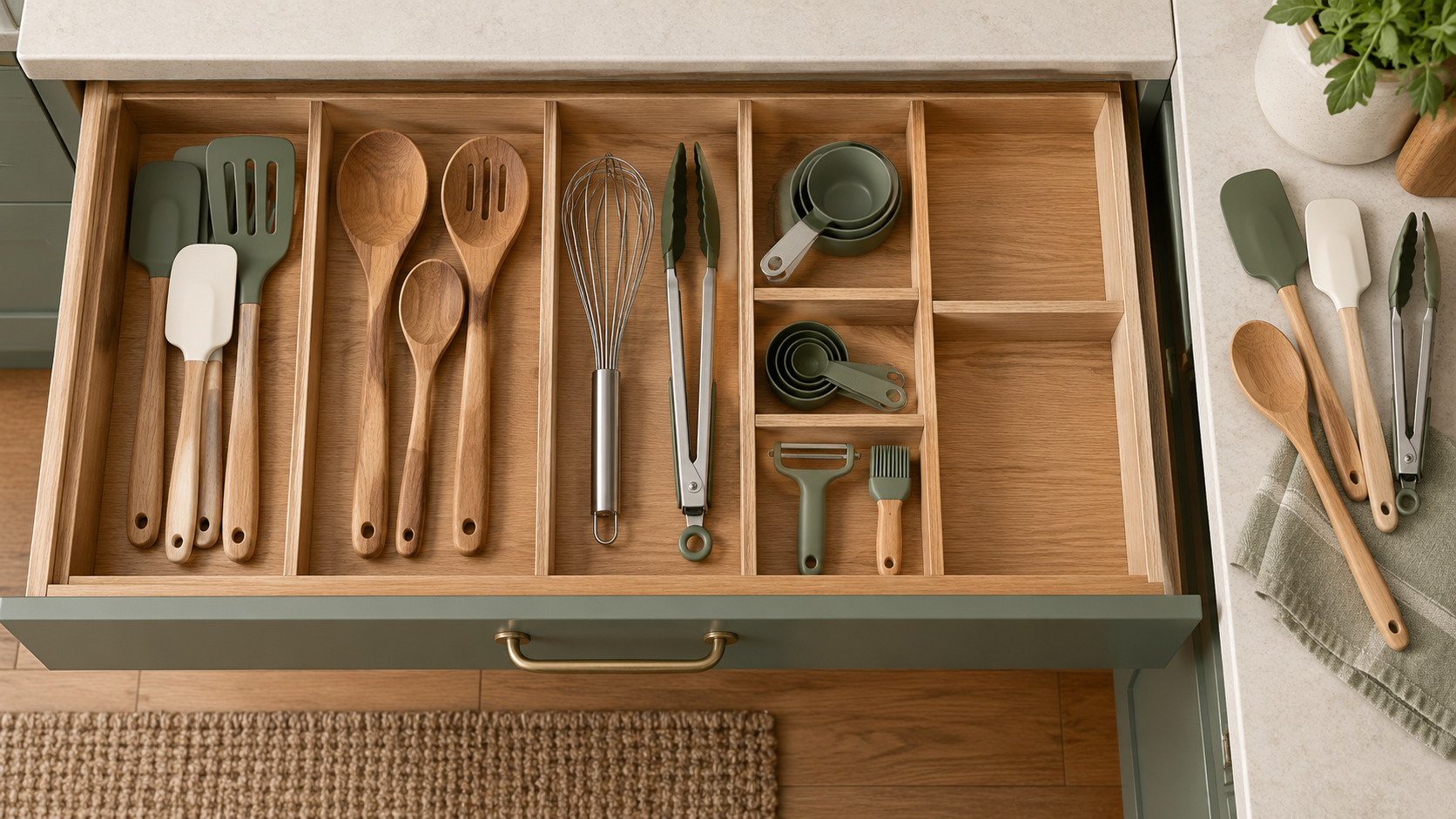
Do the same near the cooking and serving areas. Keep the groups practical rather than overly specific. Most households do not need a separate category for every kind of spoon. They need to find the tool they want and return it without rearranging six other things.
Here’s one way to group a typical kitchen:
- Preparation tools: peelers, measuring tools and other items used at the main work surface.
- Cooking tools: the utensils you regularly use at the stove, kept in a drawer beside it rather than directly under the heat.
- Everyday eating utensils: an accessible drawer near the place dishes are put away or meals are served.
- Occasional tools: a less convenient drawer that does not displace daily items.
- Small miscellaneous items: a separate, limited area outside the working utensil drawer.
This is a planning example, not a rule for every kitchen. A small Sacramento kitchen and a larger Palo Alto kitchen may have different drawer options. The best layout follows the available space and the household’s routine, not the number of zones in an organizing chart.
Match each drawer to its job
Different drawers suit different jobs, so they won’t all need the same setup.
- Utensil and cooking drawer: shallow, close to the stove or preparation area, with compartments sized to the tools you use most.
- Everyday eating utensils: near the dishwasher or table, so unloading and setting the table take the fewest steps.
- Deep drawer: better suited to pots, pans and lids than to small tools, which tend to disappear into the depths.
- Junk drawer: every household has one. Give it a boundary, such as a single tray, so it stops spreading into the working drawers.
Measure the inside of the drawer before choosing dividers
Measure the usable interior width, depth and height. Account for anything that stops an insert from sitting flat or the drawer from closing. Then measure the longest or most awkward tools you plan to store. A deep ladle may need a different compartment from flat utensils even when both are called cooking tools.
Dividers, expandable trays and open sections all work well when they fit the contents. Try a temporary arrangement with the items before buying products. Leave room to lift each tool out. A drawer packed so tightly that one item catches another is not finished just because it closes. Empty space can make the drawer easier to use.
If you work with Home Method Co., the team handles the measuring and sourcing of organizing products, so there’s no need to buy inserts in advance.
Keep sharp and awkward items deliberately stored
Knives and other sharp tools need suitable storage that protects the edge and the person reaching into the drawer. Use a product designed for the item and follow its instructions. Do not leave loose blades hidden beneath utensils or rely on a shallow divider that lets them shift.
For long or bulky tools, try an open section instead of forcing everything into narrow slots. Tongs, rolling pins and larger serving pieces may sit more comfortably in a different drawer. It is fine for two drawers to use different organizing products because their contents have different shapes.
Think about who needs access. A child helping to set the table may be able to use an everyday utensil drawer while sharp tools remain appropriately stored elsewhere. Make those choices for your household rather than copying a photo with every drawer open.
Give duplicates and occasional tools a decision
When several tools do the same job, compare their condition and how often you use them. You may keep more than one because you cook often or run the dishwasher between meals. You may also find that a broken spare has stayed in the drawer simply because nobody made a decision about it.
There is no universal number of spatulas a home should own. The useful limit is whether the drawer holds the items you use without making them hard to retrieve. Move occasional equipment to a clearly defined place instead of squeezing it beneath everyday tools.
If another household member cooks differently, include them in the arrangement. A system that only one person understands will take more effort to maintain. Show where the main groups belong, and make returning an item as easy as taking it out.
Check the layout after several meals
Cook, unload the dishwasher and set the table with the new arrangement. Notice any repeated extra steps. If you keep carrying the same tool across the kitchen, try moving it. If one compartment fills with unrelated items, clarify what belongs there and where the other items should go.
Nobody needs a spotless kitchen before the team arrives, and that’s part of how Home Method Co. works. Seeing your ordinary kitchen helps reveal these routines. Whether you make the changes yourself or ask for help, judge the drawer by how it normally functions. Your next improvement should solve a specific inconvenience you’ve actually noticed.
Want a kitchen setup planned around your routine?Schedule a free consultation with Home Method Co. to talk through your kitchen, your habits and the help you’d like, or call (916) 471-4323. The team works with clients in Sacramento, San Jose, Palo Alto and across Silicon Valley.