

If you want to know how to organize a fridge and have it still be organized a month later, the answer has less to do with buying matching bins than with deciding what each shelf is for and then putting things back on the right one.
A fridge goes wrong faster than any other storage in a house because five or six things go into it every week and nothing has an assigned spot. Groceries land wherever there is a gap. Two weeks later there are three open jars of the same thing and a bag of spinach nobody can see. This takes about an hour to fix.
The quick version: empty it one shelf at a time so you are never staring at a bare fridge and a full counter, wipe the shelves while they are out, give every shelf one job, keep the leftovers at eye level at the front, and put nothing you care about in the door.
Empty it one shelf at a time
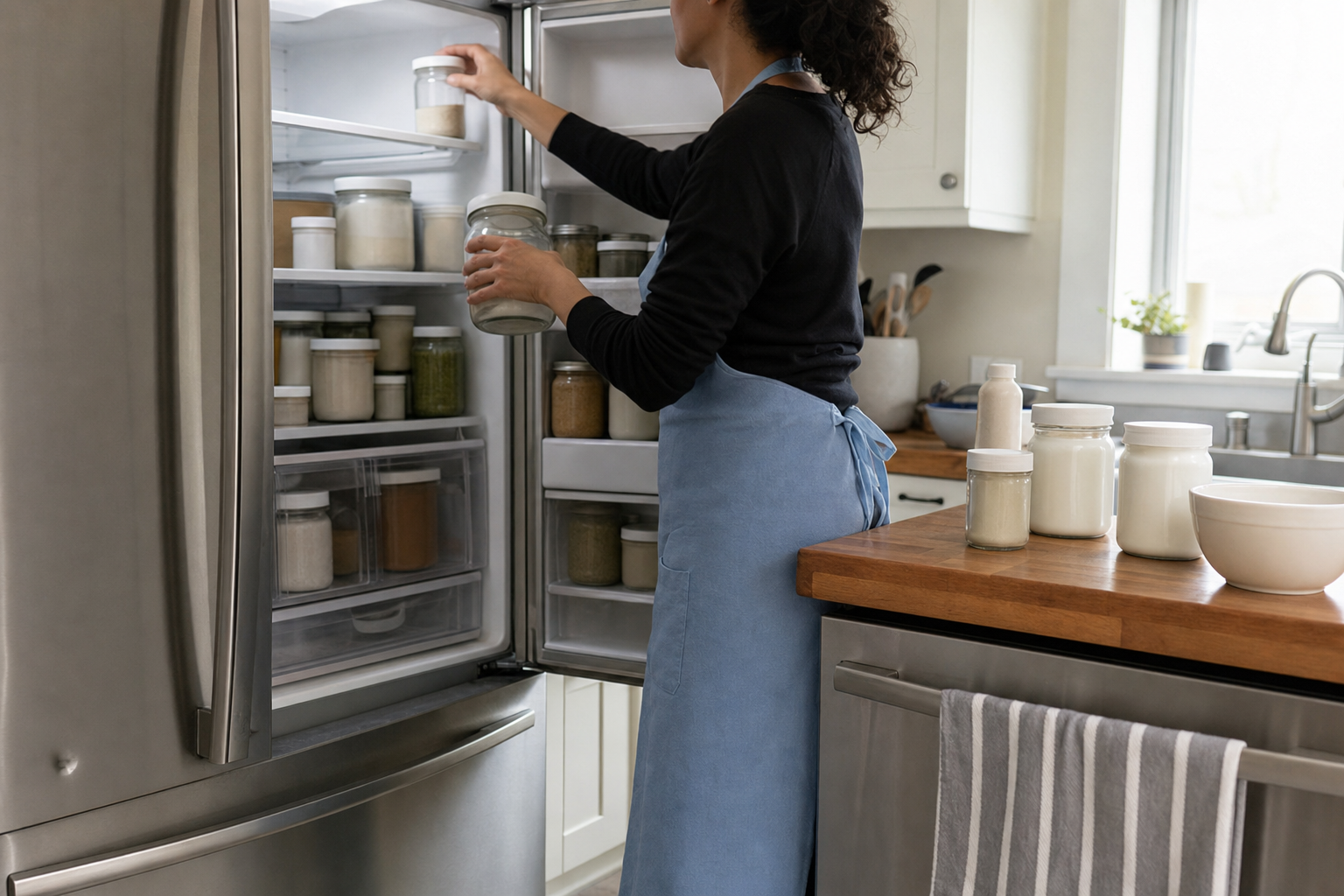
Do not pull everything out at once. Take one shelf, put its contents on the counter, deal with that shelf, and put things back before you move to the next one.
Working one shelf at a time keeps the food cold and keeps the counter usable. It also means that if you get interrupted halfway through, which happens, you have finished shelves rather than a kitchen full of open containers. Throw out the obvious things as you go: the jars nobody has opened in a year, the takeaway containers, anything past its date.
Wipe the shelves while they are empty
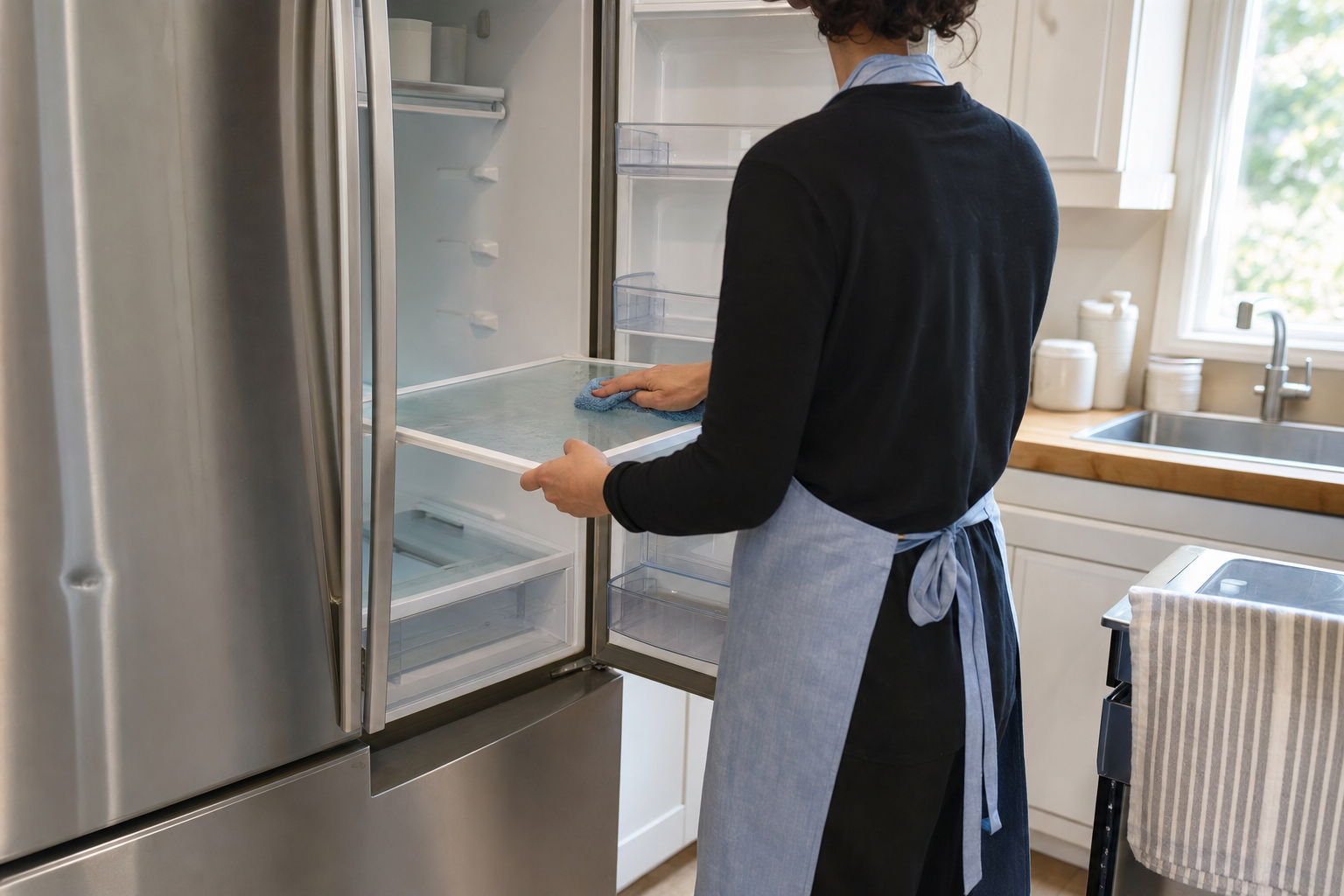
With a shelf empty, pull it out and wipe it down, top and underside, then wipe the wall of the fridge behind where it sits. Warm water and a little dish soap is enough.
This is worth the ten extra minutes because a sticky ring on a glass shelf is what makes people give up on a fridge and stop trying. It is also the only time you will ever have easy access to the back corners, and the back corners are where the smell usually is. Dry each shelf before you slide it back so nothing sticks to it.
Give every shelf one job
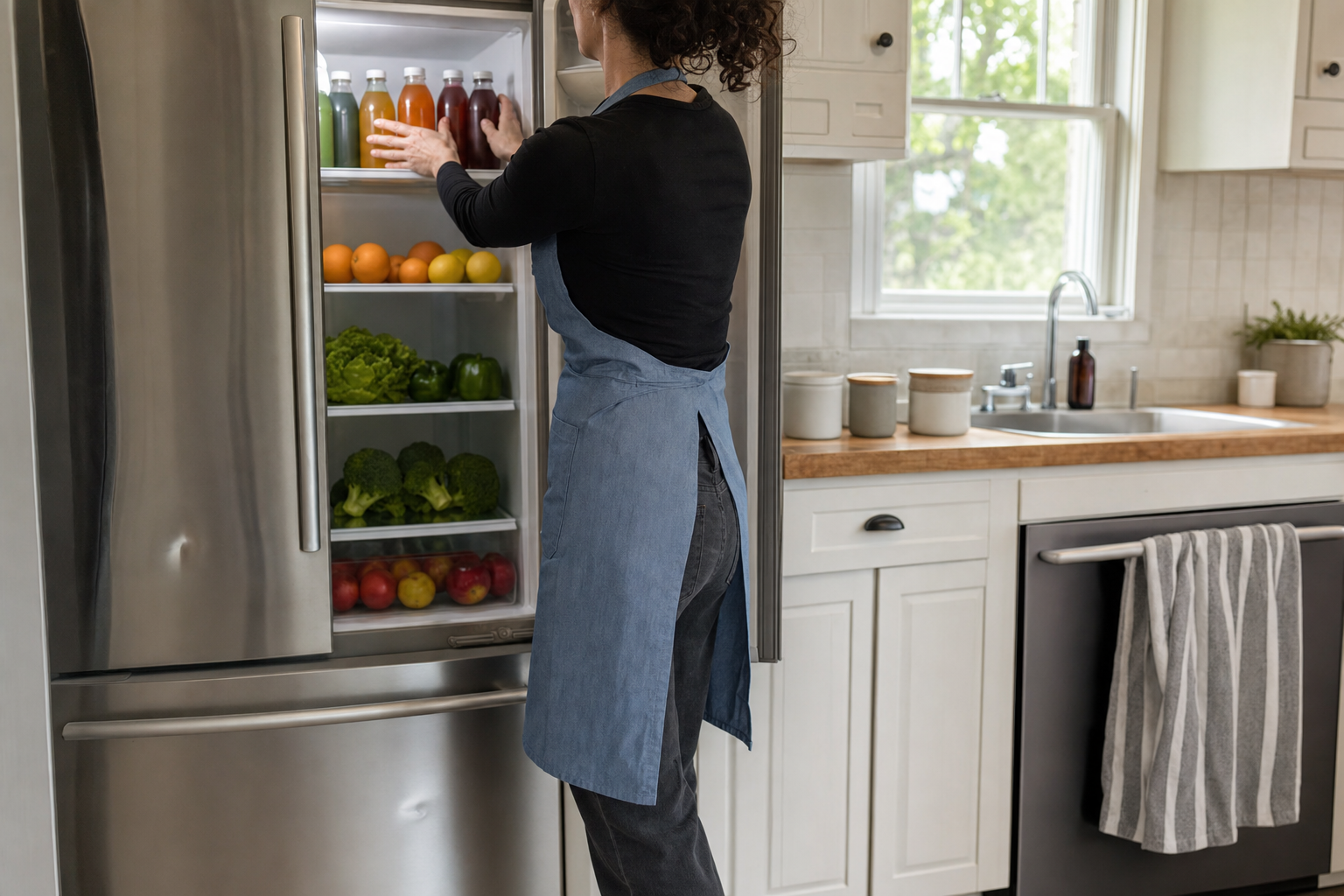
This is the part that makes the difference. Each shelf gets a category and only that category goes on it. When you unpack groceries you are not deciding anything, you are just putting things where they go.
Temperature is not even across a fridge, and that decides some of it for you. The top is the warmest part of the cabinet, the bottom shelf is the coldest, and the door is warmer than any of them because it swings into the room several times a day. Here is the layout I use.
| Shelf | What goes there | Why |
|---|---|---|
| Top shelf | Drinks, and anything that does not need cooking | It is the warmest shelf, so it suits things that are safe at a slightly higher temperature |
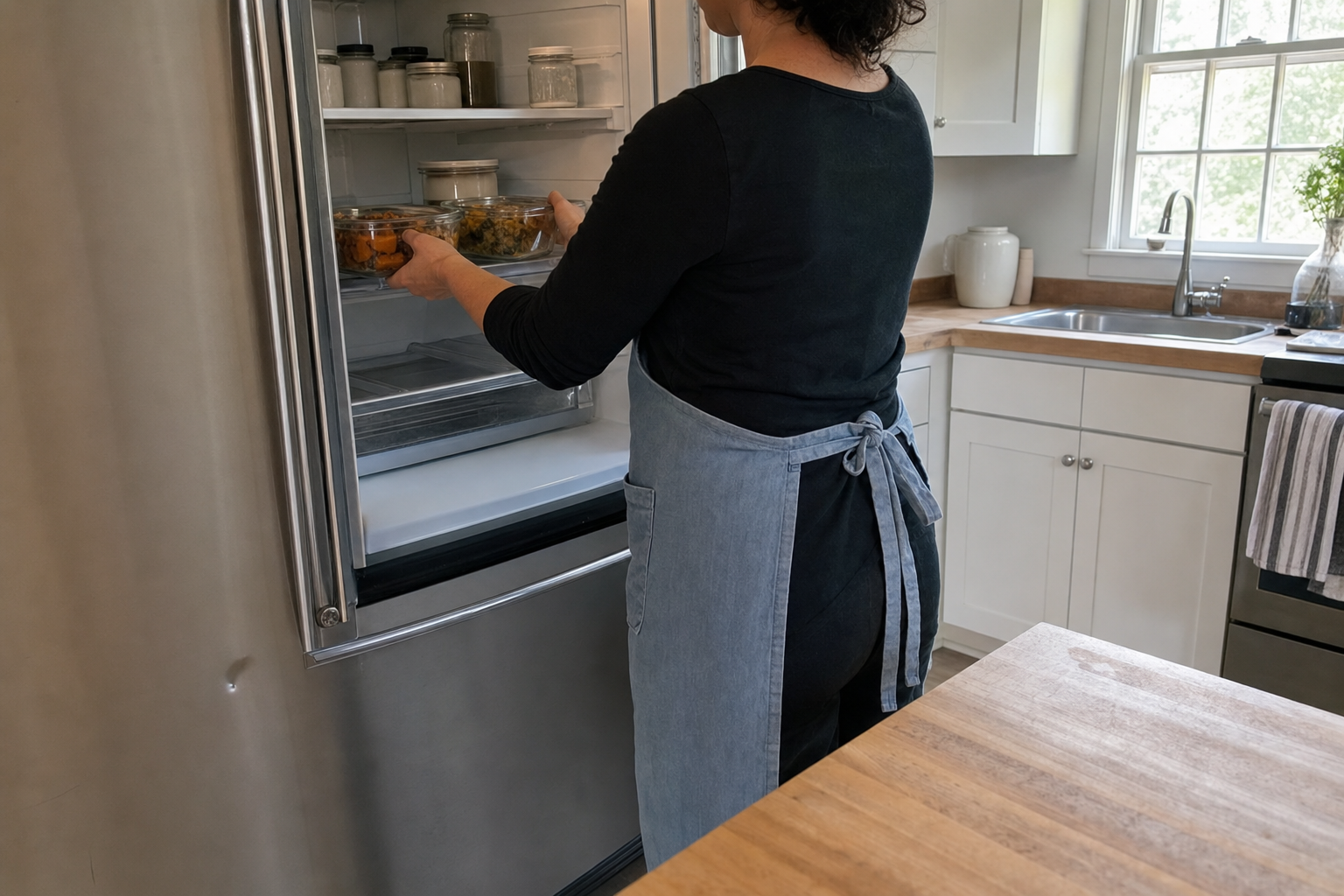
| Middle shelf | Leftovers and ready to eat food, at the front | It is at eye level, so you see it before it goes off |
| Middle shelf, back | Dairy, eggs, and yoghurt | Steady temperature, and out of the way of the door swing |
| Bottom shelf | Raw meat and fish, on a tray | Coldest shelf, and nothing can drip onto food below it |
| Crisper drawers | Fruit in one, vegetables in the other | They hold humidity, and fruit and vegetables keep better apart |
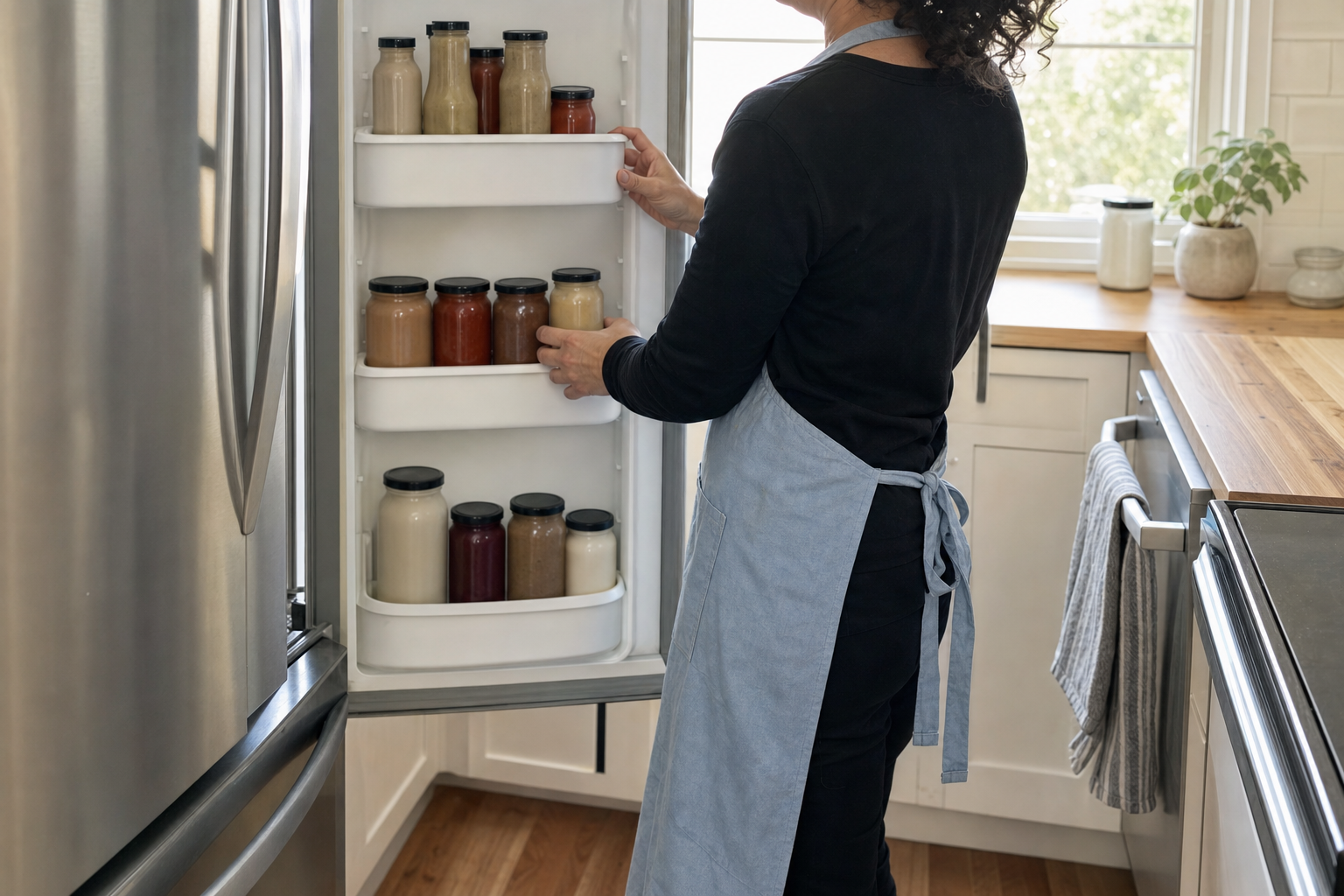
| Door | Condiments, sauces, and pickled things | Warmest spot in the fridge, so only things that keep well belong here |
The reasoning is the same one we use on a closet organizer project. What you reach for daily goes at eye level, what you reach for rarely goes high or low, and every category has one home rather than three.
Use the drawers for what they were built for
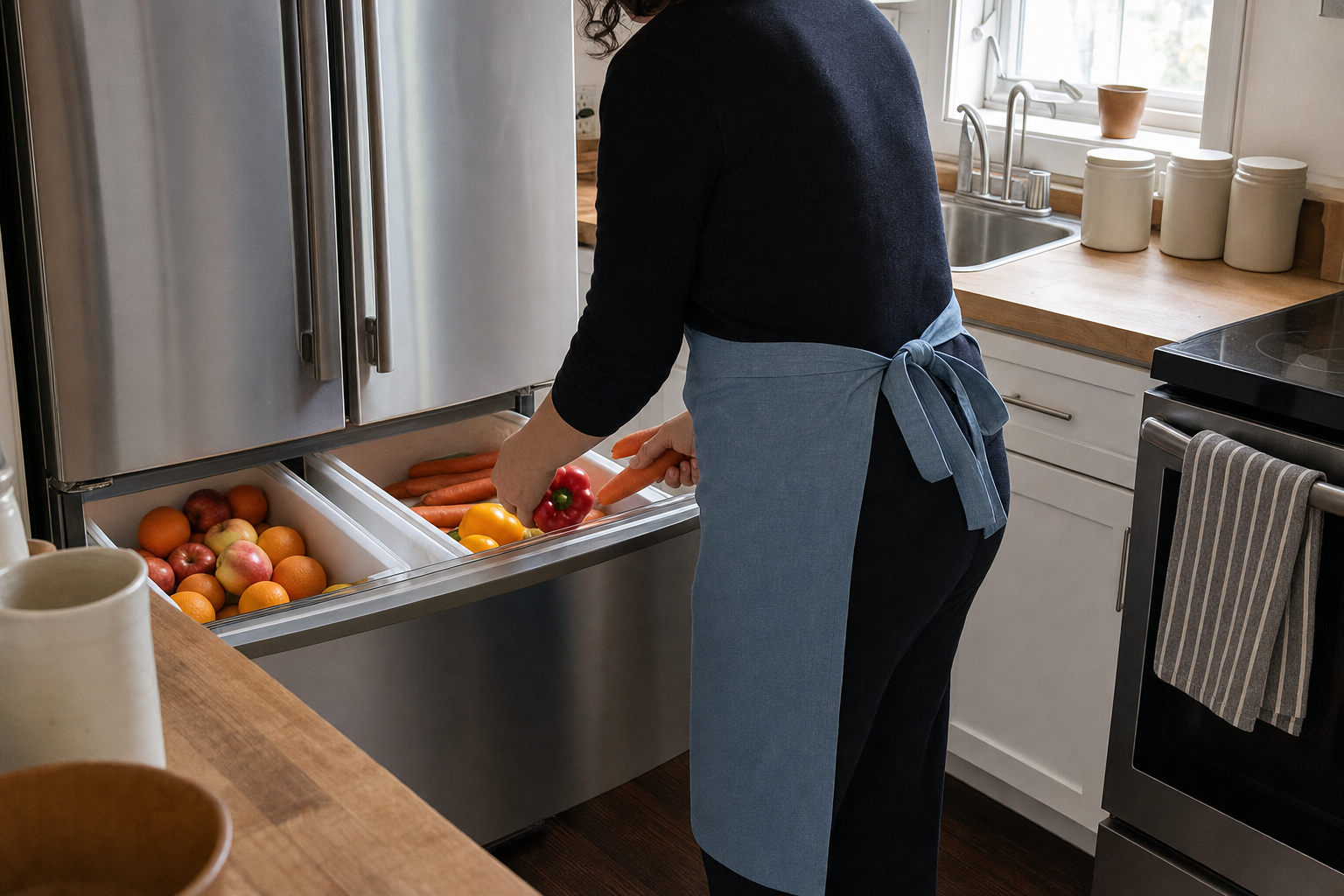
The crisper drawers have a slider on the front that changes how much air gets in, which changes the humidity inside. Most people never touch it, and both drawers end up as a place where produce goes to be forgotten.
Set one drawer to high humidity for vegetables and the other to low humidity for fruit, then keep them separate. A lot of fruit gives off a gas as it ripens that makes vegetables next to it go soft faster, so keeping them apart genuinely buys you a few days. Do not stack the drawers to the top either. Air has to move around produce or the bottom layer goes first.
Put the leftovers where you will see them
Leftovers thrown away uneaten are the biggest waste in most fridges, and it is nearly always because they went to the back of a shelf behind something taller.
Give leftovers one shallow open bin at the front of the middle shelf, right at eye level, and let nothing else use that bin. When you open the door, that is the first thing you see. Clear containers help for the same reason. You will eat something you can see, and you will not eat a foil covered bowl you have to lift down to identify.
Use the same bin for anything else that needs eating soon, like half a melon or an open pack of ham, so everything on a short clock is in one place.
The door is the warmest part
The door swings open into a warm kitchen several times a day, so it is the least stable spot in the fridge. Condiments, sauces, pickles and jam are fine there because they are made to keep. Milk and eggs are not, even though most doors have a moulded shelf that looks like it was designed for them.
Line the door up with the tall bottles at the back and the short jars in front so you can see every label without moving anything. Door shelves get disorganized without anyone noticing, because things pushed to the back of them are hard to see, and once you cannot see something you buy a second one.
A five minute reset before you shop
The layout only holds if something resets it, and the natural moment is right before a grocery run, when the fridge is at its emptiest anyway.
- Take out anything past its date and anything you know nobody will eat.
- Move whatever needs eating this week into the leftovers bin at the front.
- Push everything else back onto its assigned shelf, since a week of normal use always moves a few things.
- Wipe any shelf that needs it while there is space to reach it.
- Write your shopping list from the shelves you can now see, which is where the fridge starts saving you money.
Five minutes before a shop beats an hour on a Saturday, and it means the fridge never gets far enough gone to need the full pass again.
When the fridge is part of a bigger job
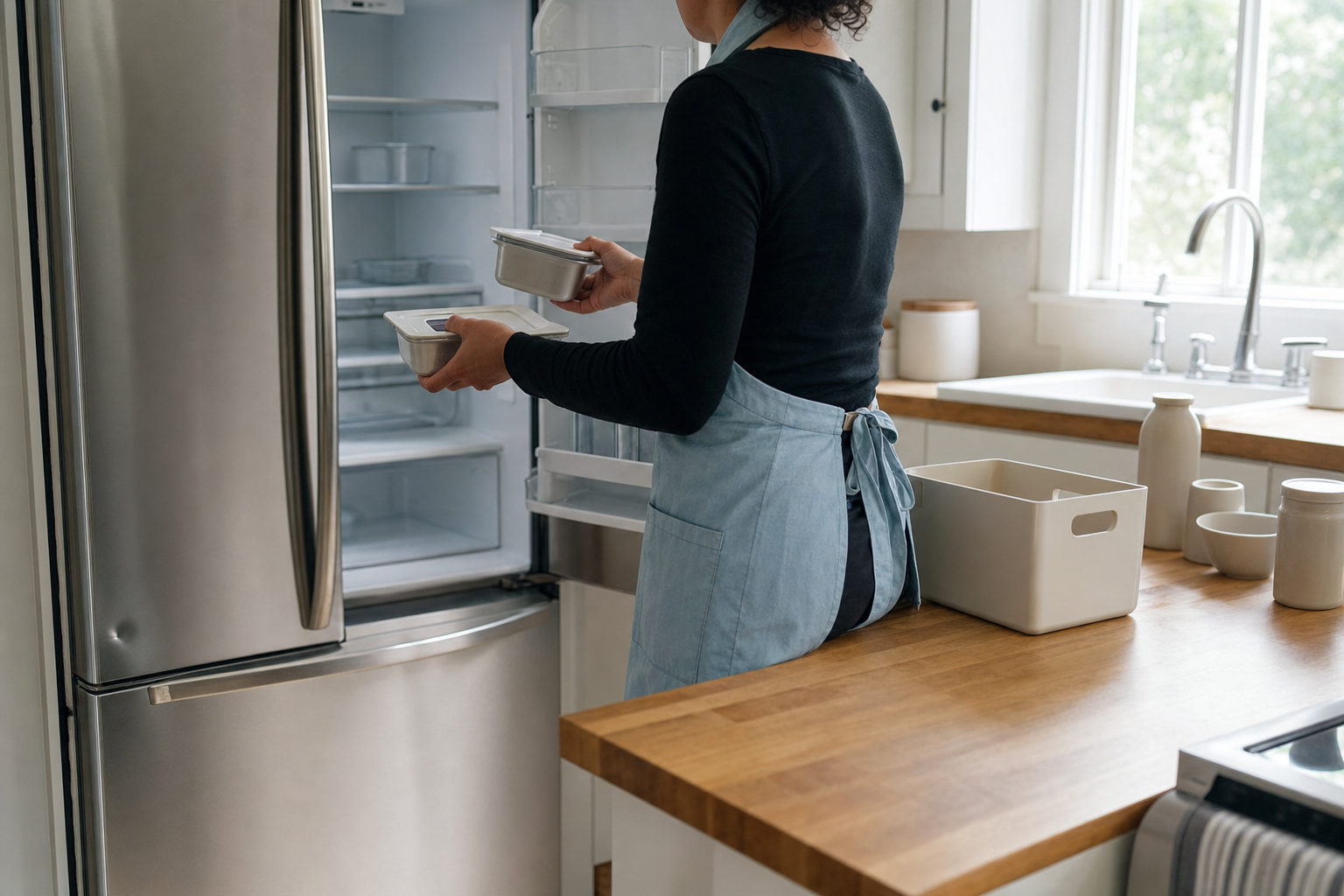
Two situations turn a fridge from a Saturday task into part of something larger. The first is a kitchen that has stopped working overall, where the fridge is only the loudest symptom and the pantry and cabinets are in the same shape. The second is a move.
On a move the fridge is one of the last things to come apart, and it is easy to leave until the day itself and then be standing in front of it with the truck outside. Our packing services handle the kitchen in sequence, so the fridge gets emptied and cleaned at the right point instead of in a rush.
Either way we start with a free consultation that covers roughly how long the work will take, what products are needed, and what to expect on the day, then we schedule work days in four to six hour blocks. Some projects are done in a day and most stretch into a few. We measure, source, shop and install the products ourselves, so there is nothing for you to buy in advance, and nothing leaves your house without your permission.
Please do not clean up before we get there. It is easier to see the real problem areas untouched, and we have seen worse. If you are in our area, you can see what we do as a professional organizer Sacramento, CA. Schedule a free consultation through the contact form whenever you are ready.